My research is on deep learning and computer vision: object detection, segmentation and classification in images. I worked with classical image processing and neural networks between 2010 and 2016 and moved to deep learning after 2018. In recent years my focus has been methodological soundness: patient-level or clip-level data splitting and the effect of the evaluation protocol on reported results.
Biomedical imaging
Developmental dysplasia in hip ultrasound, breast lesions in thermal images, brain tumours in MRI, coronary stenosis in angiography, and tissue perfusion with multi-modal imaging. This work is carried out together with clinicians.
- Performance Comparison of Multi-Modal Fusion Techniques in Tissue Perfusion Analysis Using Homography Calibration. Sensors, 2026.
- Angiography-Based Detection of Coronary Artery Stenosis Using YOLO Algorithm. Traitement du Signal, 2025.
- A mask R-CNN approach for detection and classification of brain tumours from MR images. Computer Methods in Biomechanics and Biomedical Engineering: Imaging & Visualization, 2024.
- A deep learning approach for automatic detection, segmentation and classification of breast lesions from thermal images. Expert Systems with Applications, 2023.
Agriculture and livestock
Body condition scoring, lameness and face recognition in dairy cows; egg fertility detection; ration formulation software. This line has continued since 2012 with animal science colleagues, and in most studies we collect the data ourselves in the field.
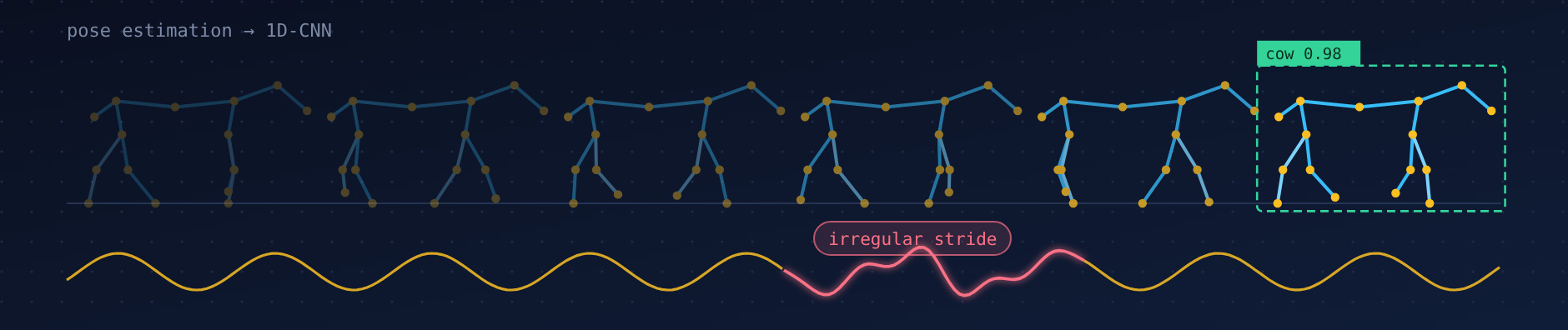
- Contactless Lameness Detection Based on Pose Estimation in Dairy Cows Using a Lightweight 1D-CNN Architecture. BMC Veterinary Research, 2026 (accepted).
- Automated Classification System Based on YOLO Architecture for Body Condition Score in Dairy Cows. Veterinary Sciences, 2024.
- Deep Learning Based Egg Fertility Detection. Veterinary Sciences, 2022.
- Deep Learning Based Real-Time Body Condition Score Classification System. IEEE Access, 2020.
Information systems, education and data analytics
Machine learning on educational and organizational data: the effect of distance education content on achievement, mobile learning, text mining, demand and consumption forecasting.
- A Transformer-Based Semantic Approach to Internet of Medical Things Applications. Electrica, 2026.
- Assessing the impact of distance education contents on learning success using machine learning. Cogent Education, 2025.
- The effect of SOS Table learning environment on mobile learning tools acceptance, motivation and mobile learning attitude in English language learning. Interactive Learning Environments, 2022.
Large language models
I am the academic advisor of an industry project on generating SQL from natural-language questions in Turkish for enterprise software.
Projects
- Investigation of the Generalizability Performance of Transformer-Based Deep Learning Architectures in the Automatic Segmentation of Coronary Artery Stenosis. Akdeniz University Scientific Research Projects, FBA-2026-7101, 2026 – ongoing, principal investigator.
- Real-Time Automated Tissue Perfusion Monitoring with Multimodal Sensing. TÜBİTAK 2219 fellowship, University of Nevada, Las Vegas, 2024 – 2025, principal investigator.
- Computer Aided Egg Fertility Control System. Akdeniz University Scientific Research Projects, FBA-2019-4898, 2019 – 2021, principal investigator.
- Development of a Textile Products Quality Control System. Techno-enterprise Capital Support, 2014 – 2015, principal investigator.
Computing infrastructure
Models are trained at the National Center for High Performance Computing at Istanbul Technical University (UHeM) and on the NVIDIA DGX Spark system at Akdeniz University.
Collaborators
Ahmet Bozkurt, Hacer Kuduz, Hasan Erdinç Koçer, Mustafa Boğa, Emre Dandıl, Güray Tonguç, and Brendan T. Morris of the University of Nevada, Las Vegas.
Graduate supervision
I supervise master’s and doctoral theses in the Management Information Systems programme of the Institute of Social Sciences at Akdeniz University. Current topics: digital traces of exam behaviour, software developers’ trust in AI tools, the wearable health technology market, pre-screening of gifted students, and the appropriateness of emergency department visits. Prospective students are welcome to e-mail a short CV and the topic they are interested in.
The full list is on the Publications page.